Versión en Español
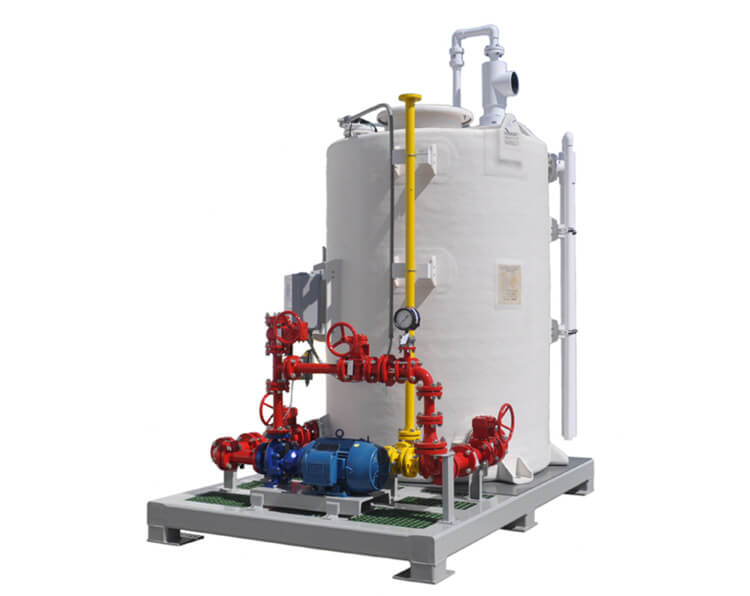
ProVent Equipment Scrubber
for use with Chlorine or Sulfur Dioxide
The Powell ProVent Equipment Scrubber
is designed to evacuate transfer hoses, piping, and vaporizers used for chlorine
or sulfur dioxide process systems. The Powell ProVent, which can be sized for your
specific needs, recirculates a caustic soda solution through an eductor to safely neutralize any chlorine remaining in the hoses or piping.
In case of power failure, the scrubber can still neutralize chlorine or sulfur dioxide
under pressure.
Other features of the Powell ProVent include:
- Tefzel®-lined magnetic drive pump or optional titanium pump.
- Fiberglass tank.
- Tefzel®-lined steel eductor.
- PTFE®-lined steel pipe and fittings.
- Oxidation reduction potential (ORP) system.
- Nema 4x FRP control panel using an Allen Bradley Micrologix® processor.
Case Study: Safety Relief Valve Changed at Customer Sites with Use of Powell ProVent Chlorine
Equipment Scrubber
Problem
Two bleach producers experienced similar problems under unrelated circumstances.
In one instance, the producer, a major bleach manufacturer in the midwest, experienced
a small leak on the safety relief valve of a 90-ton chlorine car connected to a
Powell Continuous Bleach Plant System. Although the safety valve was successfully
capped without incident using a C kit, and the liquid chlorine was processed to
make bleach, a small liquid heel and gas chlorine were left in the 90-ton car.
Due to increased regulatory and safety concerns from the railroad companies and
US Department of Transportation, before the car could be returned, it would have
to be evacuated and the safety relief valve changed on site. Initially, the chlorine
producer proposed to use two empty 90-ton cars under vacuum. This method was not
guaranteed to work since the success of the operation depended upon the amount of
chlorine remaining in the tank car. Also, the procedure would be time consuming
— and expensive.
In a similar situation, a major bleach producer on the east coast also experienced
a safety relief valve leak on a chlorine car. As in the scenario above, the safety
relief valve was to be replaced after the tank car was unloaded and before it was
returned to Chlorine Supplier.
Solution
During a review of possible methods to change out the safety relief valve between
the chlorine producer and the owner of the midwest facility, it was discussed that
the owner had a Powell Provent chlorine scrubber. After discussion with Powell,
it was determined the chlorine scrubber was designed to pull vacuums on piping and
containers and would, in fact, remove the remaining liquid and vapor from the car.
After the decision was made to utilize the Powell Provent Chlorine Scrubber, in
just a few hours of operation the chlorine car was emptied and the safety relief
valve was successfully changed on the car.
The owner of the east coast facility also had a Powell Provent
Chlorine Scrubber and the Powell Scrubber was used to pull a vacuum on the tank
car and evacuate all chlorine at that facility as well. In both cases, the procedure
to change the safety relief valve was essentially the same. After evacuation of
the chlorine, the Powell Scrubber at the east coast facility was turned off and,
as a precaution, the tank car was purged with dry air at 150 psi from the Powell Dry Air Padding System (shown on right). The Powell Scrubber was
then turned on to evacuate the remaining chlorine and dry air.
While the Powell Scrubber was in operation, and drawing a vacuum on the tank car,
a crew sent by the supplier of the chlorine removed the leaking safety relief valve
and replaced it with a new one. The car was again pressurized with dry air to 150
psi and checked for leaks. Since there were no leaks, the event was considered successfully
concluded and the car was returned to the chlorine supplier.
The photo to the left shows safety relief valve removed. The process was completed
in the field with the aid of a Powell Provent Chlorine Scrubber designed to pull
a vacuum.