USA
USA
Latin America
Brazil & Portugal
888-800-2310 (Toll Free) 989-681-2158 (Local/International) 740 E Monroe Road, St. Louis, MI 48880
517-579-3061 Teléfono en México: 55-5351-3093 info@brinechlor.com
55-13-997855697

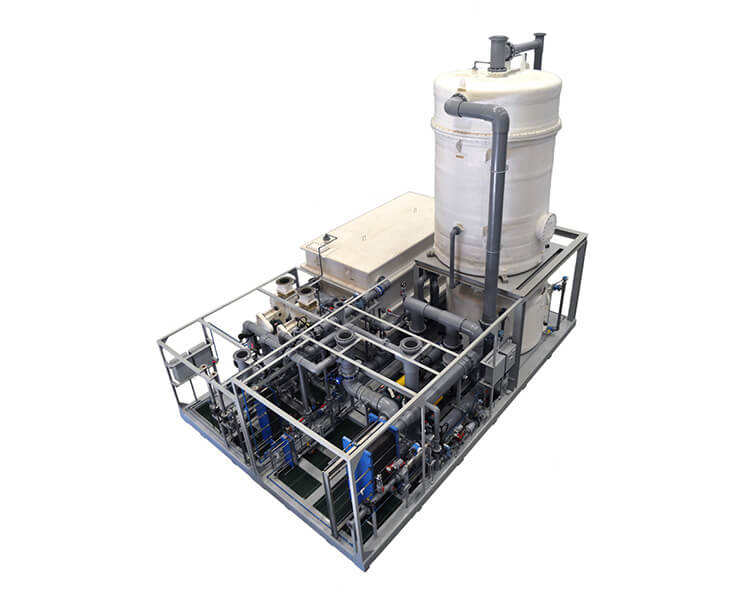
Our Sodium Hypochlorite Wet Chlorine Production System is a continuous system designed to safely produce high-quality sodium hypochlorite utilizing wet vapor chlorine and sodium hydroxide directly from a chlor-alkali process. The system is constructed with the highest quality components available to ensure long service life with a minimum amount of maintenance. It is equipped with numerous safety devices which are intended to shut down the system in the event of a process upset. It is completely automated and requires only that someone be available if a process upset occurs.
The system is available in various production rates. Product strength and residual caustic levels are controlled at very high tolerances and can be adjusted at any time during production. The system is designed for automatic operation and can be started or stopped at any moment.
Producers utilizing the Sodium Hypochlorite Wet Chlorine Production System will considerably reduce the man-hours required to manufacture sodium hypochlorite in comparison to other production processes. Typically, the system can be operated by a single operator, occupying between a quarter to half their time, and still produce the necessary amount of sodium hypochlorite, all within an 8-hour workday.
It also offers major cost savings in raw materials due to its 99.5% plus efficiency when compared against the 93-96% efficiency experienced in batch operations. This increase in efficiency results in a decrease in the amount of sodium chlorate produced.
Due to an extremely high repeatability of the system, considerable savings are experienced from using fewer raw materials. Residual caustic levels can be lowered, and final product strengths can be closer to the producer’s guaranteed strength, resulting in less product giveaway.
The type of cooling utilized by the Sodium Hypochlorite Wet Chlorine Production System also provides major savings. While mechanical refrigeration is typically required with other processes, it utilizes cooling tower water and heat exchangers, resulting in considerable energy savings, lower equipment costs, and lower maintenance costs.
Our systems are built for a capacity specific to customer requirements. The Sodium Hypochlorite Wet Chlorine Production Systems are rated to consume anywhere between 1 – 9 short tons of chlorine per hour. Contact us if your project requires a higher or lower flow rate. Standard systems have adjustable production rates and can produce as much as 220,000 gallons 818 m3 of 200 grams per liter available chlorine of sodium hypochlorite in 24-hours.
These systems are accurate and will meet allowable variations between system set points and final product strength. Accuracy is dependent on the flow measurement device, but a typical system would have an accuracy of ±2 g/L available chlorine produced.
Engineered to have a repeatable final product strength. You can expect these systems to have repeatability with less than 1% variance.
Typically has a turndown ratio of 10:1, which is the ratio of the design capacity to the minimum rated capacity.
We provide process equipment and instrumentation based on the required performance and price points of the customer and can use a variety of manufacturers to meet existing plant specifications. These systems are shipped fully assembled and programmed after being electrically and hydrostatically tested.
We utilize industrial PLC control systems such as Allen Bradley and Siemens. Control systems are installed in weatherproof enclosures and typically affixed to the process system frame if not remote mounted. A touch screen HMI (Human Machine Interface) is typically included so that the operator can easily view all critical process data. This information can easily be networked to other Powell equipment, an existing DCS (Distributed Control System), or other control systems using several common protocols. It utilizes VPN devices which provide a secure, remote connection to the system, and allows us to provide programming updates and assist in troubleshooting when necessary. A comprehensive Operation & Maintenance Manual is provided with every system and includes complete electrical prints and programming logic. We provide UL listed or CE marked control panels and meet a variety of electrical classifications.
Each project undergoes an engineering review to ensure the materials of construction are appropriate for the project specific process conditions. Each reactant stream may have different materials of construction. Testing, X-ray services, and pipe welding to meet international and domestic standards such as ASME B31.3 are also available. Process piping connections are typically 150# ANSI flanged, and standard skid components are as follows:
We also provide a variety of tie point locations, flow directions, and frame configurations to meet project specific constraints. Our systems are modular in nature and skid dimensions are taken into consideration for the need of transport via truck or shipping container.
Chlorine at maximum of 104°F (40°C).
Sodium hydroxide up to 50% at 45-80 PSIG (5.5 – 6.2 bar).
Softened water at 45-80 PSIG (5.5 – 6.2 bar).
An uninterrupted source of single-phase power is required for the control system. A UPS (Uninterruptible Power Supply) can be provided if necessary. A source of three-phase power is also required for all motors.
Clean, dry, oil-free instrument air at a minimum of 80 PSIG (6.2 bar).
Cooling water at a maximum of 85°F (29.4°C).
We assist you by providing a variety of upstream and downstream equipment, instrumentation, and automation as well as motor starters and drives, as required by the client. Functions such as tank truck loading, bottling operations, tank farm management, including integration with existing controls, networks, and distributed control systems lead to greater safety, increased efficiency, and improved productivity. We also provide a properly engineered cooling water system, complete with cooling tower, cooling water pump, and a “chemical-free” method of treating the cooling water.
Our systems are supported by our experienced technicians who can provide startup, operator training or perform scheduled preventive maintenance and calibration. Additional charges apply for these services.